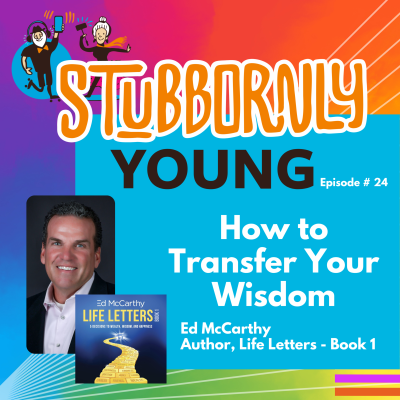
I’ve always wondered if it’s possible for me to transfer my head FULL of wisdom to, well, optimally, my sons – and if not them, to ANYONE! Thinking back, as a much younger man did I absorb wisdom from others? Ed McCarthy, author of Life Letters (Book 1 – 2 and 3 to follow) describes the lack of wisdom transfer as a sad loss of the most valuable resource. After a near death experience he described in Life Letters, he decided to try to FIX this problem. Ed designed the Wisdom Transfer Platform to do just that – and to let you and me do it too. This is a very thoughtful conversation – you’ll enjoy learning more about “wisdom transfer” and it will give you ideas about how to approach that in your own life.
Full Transcript (searchable):
SUMMARY KEYWORDS
Wisdom transfer, Life Letters, Ed McCarthy, Stubbornly Young, generational wisdom, Wisdom Transfer Platform, personal stories, gratitude, accountability, decision-making, storytelling, integrity, lifestyle design, book series, social media platform.
SPEAKERS
Speaker 1, Dave Tabor, Speaker 2, Ed McCarthy, Author, Life Letters
Ed McCarthy, Author, Life Letters 00:04
I feel that wisdom is humanity’s greatest wasted natural resource. When trying to help solve this injustice of the lack of wisdom transfer from one generation to the other, I don’t have all the answers, and that’s why I created the wisdom transfer platform to get everybody to share their wisdom. They’ll hear something that I’ve said 10 times, and they’ll hear it from another source, and be like, oh, that’s a great idea. It was the first time they heard it.
Dave Tabor 00:36
People don’t listen to people preaching, you know, wisdom. They want to engage. How do you manage that fine line? Welcome to the Stubbornly Young Podcast, for people in their 50s, 60s, and beyond who want to stay engaged in the world and relevant to the younger people in their lives. I’m Dave Tabor, and, like you, I’m on a journey of figuring out what middle age is, and as I get older, moving forward in a way that’s exciting and purposeful for me. I don’t have the answers. I’m exploring by talking with lots of people who have ideas that can get me closer, and I created Stubbornly Young to share my conversations with you. This is episode 24 and I’ll be speaking with Ed McCarthy, author of Life Letters: Five Decisions to Wealth, Wisdom, and Happiness. Ed’s book is a pleasant read, and it makes me really wonder about how to deliver my wisdom to my kids. Do they even want it? Really, and maybe my wisdom to others who might be, I don’t know, would they be eager possibly to have it. So, Ed, glad we’re talking today. Glad you’re on stubbornly young.
Ed McCarthy, Author, Life Letters 01:38
Thanks for having me, Dave. Appreciate it.
Dave Tabor 01:39
Yeah, now normally, because I’m an impatient sort, I dive right into the content. I think in this case it would be useful for listeners to understand just a little bit about what you were doing before you took on this project.
Ed McCarthy, Author, Life Letters 01:52
Oh, yeah. Oh, well, I guess first and foremost, I’m an accidental author. It was never intended and never said I want to write a book, so previous before I became an author, I spent 30 years, three decades, and ultimately CEO of several software companies. So, I spent almost three decades in the high-tech industry. I pivoted, kind of at the same time I was still in high tech, I started to build, get into real estate really after the 2008 crash and got heavy into real estate, so then I built a real estate empire through another entrepreneurial venture, and, and that kind of led me to this, this, this, this next phase of my career, being stubbornly young, continue to be stubbornly, reinvent, reinvented myself, and trying something new, which is this life letters, which you know, quick snapshot of the book. This is what it looks like. It’s the life letters, and it’s five decisions to wealth, wisdom, and happiness, and the whole premise is follow the path to your highest self through through optimal lifestyle design. So it’s been a really fun adventure, and hoping to keep me young.
Dave Tabor 03:05
Yes, and, and what’s intriguing. I had to start with the very beginning, like, you know, this is sort of like a passion for you to share, and it says so in the dedication, you know, to your children. I could, I, that you wrote, I’m going to read this. I wrote this book of life letters to share what I’ve learned during my journey. Sound advice, while heated, can make all the difference. So, I’ve got two adult sons, and I always wonder. My wife constantly reminds me that maybe our kids don’t want my advice. Maybe the wisdom that I believe is so massive in my brain, waiting to get out, maybe they just don’t want
Speaker 1 03:42
it. Yeah,
Dave Tabor 03:42
what do you think about that?
Ed McCarthy, Author, Life Letters 03:44
Well, I find I find wisdom of the older crowds, either they don’t call it the grandfather, like a grandparent level, or they’re, you know, the parent level, especially with adult kids and teenagers. You know, I feel that wisdom is is humanity’s greatest wasted natural resource. It’s there’s so much wisdom at every different generation across the board that we should have more in our societal framework that we should look for the, you know, for the younger to look to the middle age to the older and share that wisdom openly, but there really has been no mechanism to do that, other cultures do, they, you know, I’ve spent time in Japan, and other, and their cultures tend to, Asian cultures tend to gravitate towards respecting your elders and listening to them for advice. We don’t really have that so much in the West, and it’s unfortunate. I think it’s that’s the fault of everyone, or the loss of everyone, and that’s why I created through this, this life letters book has morphed into many different things. It became a best seller. It’s, you know, we have sales in 11 different countries, it’s being converted to different languages, it’s being nominated for book awards. It’s been really transformational, but. One of the fallouts of that is I’m trying to help solve this, this, this injustice of the lack of wisdom transfer from one generation to the other. So, I created what we call the Wisdom Transfer Platform, and it’s on our website, which is the Life letters.com T H E Life letters.com and the Wisdom Transfer Platform is just that it’s a first of its kind social media platform for others to share their wisdom with, with, with, with the world, right. So, and I think it’s gonna be really well received.
Dave Tabor 05:31
Yeah, and you can, anybody, any, and the readers of your book are encouraged to submit to this portal, to this website. Now, it’s kind of like the proverbial, if a tree falls in the woods and no one hears it, did it make a sound? If all people your age, my age, all of us wise guys, no wise people have all this wisdom, all this life lesson, like if we want to share it, but young people, I mean, to me it’s almost biological that they don’t care about this stuff until they get older, where they’ve learned the hard way. So, like, is this just like that? If a tree falls in the woods and no one hears,
Ed McCarthy, Author, Life Letters 06:12
often is, unfortunately, but it shouldn’t be. That’s the injustice, right? So, and I think we, you know, we can create, and I have been, you know, building a movement around this to try to address this injustice, and that’s what I refer to as the Wisdom Transfer Platform, and really what this book is, Life Letters, right? It’s my life in letters, and it’s A through Z, and ultimately it’s it’s my best attempt to transfer my wisdom to really, I wrote it for my kids, who are now teenagers, right, late late teens, and so it was my best attempt to share my experiences to them, and but I’m just one guy with one life and one life’s experience. I don’t have all the answers, and that’s why I created the Wisdom Transfer Platform to get everybody to share their wisdom for those that are actually seeking
Dave Tabor 07:02
it, I gotta dig into this a little further, because you can round up 1000 me people and you people, and you know our spouses and others, and you know there are 1000s of us all adding wisdom. What evidence do you have so far that younger people are you looking at it, reading it, using it, experiencing
Ed McCarthy, Author, Life Letters 07:29
it. Oh, I, that’s been one of the pleasant surprises through this. I mean, I, when I wrote this, I was like, I was hoping if I, the book would be, all the effort is a tremendous amount of time and effort, and I thought, you know, how do I measure success, like, how do I measure if this was worth it or not, and I looked at it like, if only two people read it, my two children, my two, then it was worth it, right, but but this is morphed into something that I never really expected, that goes back to the accidental author, the reviews that I’m getting, and you’re welcome to look at them up at Amazon and Barnes and Noble, all over, all over our website at The Life letters.com are mostly from the young, right? They’re, you know, millennial, Gen Z, you know, Gen X, different people, and you can see they reference themselves like this is a must read for my generation. So I think there’s a tremendous thirst from the young to listen to the wisdom that is out there, and learn and grow from it. So, I think what I’ve found, many, it’s been so inspiring to me, is many reviews, you can read them yourself online, and I’m making it up, is that many people looking at me like that, you know, you’re the father figure I never had, right? You’re out, you know, I had either an absentee dad or I had a dad that just simply wasn’t involved, it wasn’t engaged, and I’m giving them that fatherly advice, that guidance on how life works and how to be successful in life, and how to have optimal lifestyle design, and so there is, without it, without a doubt, there’s a massive thirst for the young to learn, but you know, they, they, they’re selected on who they listen to.
Dave Tabor 09:12
Yes. Well, you, and to that point, that was exactly where I was going to go next. Ed, is are they listening to you, to you? Let’s say they did have a father figure, whatever you know, and or a mother with wisdom, and you know, whatever the case, but like, are they listening to you because you aren’t their father? Like, dear, you know, that’s what, like, I think if I wrote my letters and then I put them up on a website with a bunch of other guys, smart guys like you, or women like my wife, people would read theirs, but like my own kids might not be as interested in what I have to. I don’t know. Are you seeing any of that?
Ed McCarthy, Author, Life Letters 09:47
Yeah, I think so. I mean, even with my own kids, I mean, they’re.. I’m super proud of both my kids, are really smart, you know. But they, they, you know, they’ll hear something that I’ve said 10 times, and they’ll hear it from another source, and be like, oh, that’s a great.. It was the first time they heard it, and I’m like the fact I told you this a dozen times, and so I think human nature is that you know, and usually I found that at least for myself, anyway, is when I was, I turned about 25 years old, all of a sudden my parents were smart, they were like, they don’t know anything, and then all of a sudden I look back and go, wow, they actually weren’t as dumb as I thought they were, and I think it just comes with, with comes with this maturity, comes with age, yeah, and acceptance, and you know that the rebel, the natural rebel part of being
Speaker 2 10:37
young,
Dave Tabor 10:37
so maybe the sweet spot is isn’t really like teenagers who you actually wrote for, but maybe the sweet spot is to your point, once once young people start to mature and they end up independent in their lives, that maybe they start valuing this kind of thing more than they would when they’re, you know, they don’t have a worry in the world.
Ed McCarthy, Author, Life Letters 10:56
Yeah, well, I’ll do it like once, like, right? I did not write this for teenagers, my kids are teenagers now, but I wrote this. I wrote this with the mindset of who I envision them. I call it avatar, so I envision what their avatar, what they would be like, where they would be approximately 30, you know, 30 to 35 They got through college, they started life, maybe they’re at, or slightly considering marriage, that type of level, you know, pre-kids or soon to have kids, and now they’re really ready to listen, and so I wrote it as that 30 year old range, but what I’ve found is there’s three different levels of people that gravitate to this book. There’s the, the young that I would call, they’re trying to invent themselves, right there, that say they say that 30 or less than 35 year old range, they’re trying to invent their life, they’re trying to create their careers, they’re trying to invent who they’re going to be. And then there’s the call at the middle age, close to the middle age, you know, that 35 to 55 or 60 who are trying to reinvent their life, right? Maybe things aren’t going as well as they thought, maybe they, you know, AI is coming in, and they’re worried about losing their job, or they’re just not happy in their career, or happy in their marriage, or something’s wrong, dealing with addiction, whatever that case may be. And now they have to reinvent themselves, and then the latter one would be like the age of, you know, maybe 60 plus, is, and I call that the cultivate. Now, those are the people that have are seasoned veterans of life, and they want to cultivate their experience and share it with others, so that that invent, you know, the younger, the reinvent, and then the cultivate seems to be the three primary areas that gravitate to this book’s
Speaker 1 12:38
message,
Dave Tabor 12:38
and the cultivate, you know, it’s like you’re stimulating them to add their thoughts through your website, which is cool.
Speaker 1 12:44
Yeah,
Dave Tabor 12:45
I want to ask you about there’s.. I’m still on page one, by the way, of dedication, and it says, as you read these words, always remember, and this is you writing to your children, as you read these words, always remember that foremost, honor and integrity matter in everything you say and do. Love, Dad, and you know it seems like, and I hope it’s not true, but it kind of seems like honor and integrity are almost old-fashioned words. What have you found about the way that kind of message resonates with the millennials that are writing back and putting reviews up and things like that.
Ed McCarthy, Author, Life Letters 13:24
Yeah, well, and I think they’re, they’re, they’re the next generation is way smarter, way more powerful, and has way more potential than most to give them credit for. So, I mean, I see my kids and their friends, they have a vast array of friends, and they’re just, just rock star young, young adults, they’re gonna be, they’re gonna, they’re gonna, you know, contribute greatly to the world and live wonderful lives. So, I think that they’re, they have strong integrity, and I think, you know, it’s, you know, they’re, you know, we’re, you know, we’re Christian, that’s a big core part of our family upbringing, you know. I, my wife homeschooled our kids, so I think that we avoided a lot of the trials and tribulations of public school, or even private school, so we, you know, so I think there’s a lot of advantages for the kids, but they, but their friends who are both private and public school, they’re not all homeschool kids, I think, are tremendous. So I think we should give those them a break. I think these kids had it hard, harder than perhaps than we did with the social media and these influences coming from all different angles for them, but they’re figuring it out, they’re there, a lot of them are going offline, they’re starting to have control of their social media presence or their screen time, so I am very, very optimistic about the future of the youth,
Dave Tabor 14:42
how do you balance sort of your sense of, I read in here a little sense of nostalgia, because you’re quoting John Wayne, and you know you, and you, how you, how you sort of adopted his mantra as a child, so in. Fact, I’ll read this to the listeners. A quote that you pulled from him, from I live most of my life in the wild country. This is from a movie, and you set a code of laws to live by. I won’t be wronged, I won’t be insulted, I won’t be laid a hand on. I don’t do these things to other people, and I require the same from them. So, you know, there’s sort of a nostalgia, but it’s also a really practical way to face life, so how do you balance that with, like, if you’re talking about John Wayne and you want to relate to people today, how do you think about that?
Ed McCarthy, Author, Life Letters 15:35
Well, I mean, that’s that is from John Wayne’s last movie, The Shootist, and I was a very young, young lad in Boston, where I grew up in a very tough environment, and it did set the bar for me. I, you know, when I watched that movie, of some reason, because I, being in a tough environment, inner city Boston, lots of lots of drugs, alcohol, lots of street fighting, I got again, got in 100 different street fights, you know, in my time was a very, very tough neighborhood, but the biggest challenge I had, I think, was was a mindset of scarcity or lack of abundance, or it was like, you know, a blue collar, both. I’m a first-generation American kid, you know, I was destined to be either a plumber, electrician, which is fine, it’s a fine trade, but, but was very, very blue collar environment, it was very limiting in thought process, so breaking out of that, that, and then, and having that, that issue of like John Wayne says, you know, I lived in the wild country, it was pretty wild where I grew up, and I wouldn’t want anyone to lay their hand on me, I wanted to insult me, and I don’t want them to touch me, so, so ultimately I implemented in my life, and it transformed my life, because then all of a sudden I had the courage to fight back, I had the courage to have faith in myself and say I want more than this, you know, very humble beginnings, Mom, Mom was a maid for the wealthy and MIT and Harvard, you know, she would clean their houses. Dad was a truck driver, so very humble beginnings, just classic immigrant kid. And so, yeah, it was ultimately be able to adopt that and implement it. So, I shared it with the readers, and perhaps that’s going to be able to help transfer other people’s lives, saying this is my rules to live by. Now you know that I provide my, my rules, or my, you know, code. I call it the code. I define my code, and I share my code with the readers, but I think the young, or even, even the, at any age, you have to define your own code, what you stand for, what your ethics are, right? Your, what do you believe in? And then have an integrity in everything you say and do is fundamental, and if you deviate from that, then lock, then life goes sideways on you pretty quick.
Dave Tabor 17:49
Yeah, I mean, it does strike me that conveying your life lessons, just this, you just wrapped up the summary of that, but conveying it using a story about how you grew up, how you had to defend yourself, how you had it, you know, these kind of like I would think that would make you relatable and effective in that way, right?
Ed McCarthy, Author, Life Letters 18:11
Yeah, yeah, hopefully it seems to be. I mean, you know, it’s the best selling book, and that every, you know, people really have related to this to this life letters, and now it’s been referred to as a movement, and it’s changing lives, and and it’s being passed on to others, and the feedback we’re getting, and you know, Amazon book reviews, or you know, even on our website, or just random emails on how this book has transformed my life, has been, it’s been encouraging, it’s just fantastic. It’s helping to keep me stubbornly young, because it gives me that motivation that to be able to.. wow, I’m here for a reason. I’m here beyond just trying to be the best dad or the best father or best friend that I can be. I’m here to help others, and that helps me remain stubbornly
Speaker 1 19:00
young.
Dave Tabor 19:00
I’m glad to hear that, and you know it. There isn’t a notion that if you continue to stay, at least in my mind, and you’re just expressing it too, that if people like you and me have something that’s exciting and that makes us happy to drive forward, right, then that is a high importance element to staying vibrant, to staying stubbornly young, to staying engaged, right?
Ed McCarthy, Author, Life Letters 19:20
I think so. I think so. That’s why I encourage all your listeners to go to our website, and again, be lifeletters.com and join the Wisdom Transfer platform. At any age or stage you are in life, we all have wisdom, we all have experiences. Again, as I alluded to earlier, I’m one guy with one life experience. I certainly don’t have all the answers, or even most of the answers, but, but please share, please, please join us, and it’s broken down into wealth, wisdom, and happiness topics. So,
Dave Tabor 19:49
yeah, so anybody can go on to the Wisdom Transfer platform, it’s called, and just sign on, just sign in, add your content, and how are you curating that,
Ed McCarthy, Author, Life Letters 19:59
I. Have a virtual assistant that actually manages it and keeps track and makes sure everything is clean and no one’s putting anything inappropriate on there, so I have just a small team that manages our website, our the WTP, or the Wisdom Transfer Platform, and our newsletter too. So we also launched four months ago, or so, launched a free newsletter, so I encourage those that go to our website, the Life letters.com and join up for our free, free newsletters.
Dave Tabor 20:27
I read a story, and I chose a few of your chapters to look at, and this one was under decisions, because I was just interested in hearing it, and another great story, which I think supports the suggestion I had earlier, that stories convey these values, these wisdoms, and so forth, more than just saying them. Tell the story about your encounter with Gary Hart on the bus.
Speaker 1 20:50
Yeah, yeah.
Dave Tabor 20:53
And first, remind us who Gary Hart is. Was yeah,
Ed McCarthy, Author, Life Letters 20:56
yeah, yeah. So Gary Hart was the front runner and seemed to be the heir apparent for the presidency, United States, so he ran, and the would be 1988 He ran for president 1988 He was a Democratic senator out of the state of Colorado. And you fast forward 1995 I got a phenomenal job opportunity. I left Boston, moved to Denver, Colorado, where I reside still to this day, some 30 years later, and, and Gary Hart, 1988 Well, he had an affair, he made a decision, apparently he didn’t argue with it, didn’t fight it, so I assume he was guilty as charged, but he had a marital affair, and basically, got you know that late, late in the stage in 1988 he got, he resigned, he resigned from the from the from the race, and and then then he resigned from the Senate, and so here I am in seven, yeah, seven years later, in 1995 I have a job in downtown Denver, and there’s Gary Hart sitting on the what’s called the Freemale Ride, it’s basically a shuttle bus that goes up and down the main drag and downtown Denver, and there he is, and nobody on the bus recognized, recognized him, he’s very distinct look, you know, a big gray hair, and 100% is him, and I’m just sitting there staring at him, and I was still young, I didn’t have the courage to go chat with them, and I should have, but here I am staring at him, and nobody on the bus knows who this guy is, right? And seven years earlier, right, he was the heir apparent to be the President of the United States, and here he is on a free shuttle bus, and no one knows him, right? And he gets off the bus, he starts walking down the street, and I get up and I’m in awe, and I just watch him as the bus starts pulling away, and he’s just an average guy walking down the street, and no one knows who he is. So I use that as a point of reference as the most extreme example of how one decision, one bad decision in this case, can alter your life. I mean, literally, as seven years later, if he would got elected, which he was supposed to be, and he got reelected. He was the president, United States at that point, only seven years later, right? He would still be the president into eight years. So it was still astonishing to me, and I used that as a point of reference, and I tried to do that through you used the word relatable earlier. I tried to do that through all my writings for book one, when I’m about to release book two later this year. Every one of my A through Z letters, each one is 26 chapters, starts off with a story, like the John Wayne story, or like the Gary Hart story. So I encourage people to, you know, to read through, and I think you’ll enjoy the stories, and verses, just not me preaching, it’s giving me giving you that my real life lessons on how I learned that particular topic.
Dave Tabor 23:46
I think that makes sense as a formulaic approach to conveying wisdom. I was struck by one of your still under the decisions chapter, it says, or you said don’t fall under the mistaken assumption that you can avoid decisions, indecision is inherently bad decision. I love that. I love that, and I think that kind of, okay, that’s just one example, but I think that kind of, well, it’s kind of a tidbit, but it really is much, much broader, much more important and impactful than a tidbit, right? But that kind of thing is like, wow, that resonated with me, because I’ve lived my entire life sometimes being indecisive, sometimes, right, and it never works ever,
Ed McCarthy, Author, Life Letters 24:30
right? Right, yeah, and that’s it. A lot of people try to hide from the reality, and they were like, well, if I don’t make any decisions, if I just wait to make that investment, or I wait to start that business, or you know, or ask that girl out, or that guy out, or whatever the case may be. All of these, or let’s stay relevant to this, you know, be that older parent that is a parent or grandparent that’s afraid to transfer their wisdom to their children, right? The timing’s not right. Well, those are all in decisions, right? You’re deciding not. Not to decide, you’re deciding not to decide, and most people don’t hold themselves accountable for their indecisions. They know, like, oh, I made it, I made that decision, and either worked or it didn’t work, and they beat themselves up if it didn’t work, like, I made a bad decision, a bad investment, or I said something inappropriate, I made a bad decision. But very few people hold themselves accountable for their indecisions, and I think that’s where most of the damage happens.
Dave Tabor 25:25
That’s brilliant, actually, really brilliant. I’ve made some, because I’ve been lamenting, actually, I’ve made some bad financial decisions in the course of my life, and where I’ve lost, you know, sizable amounts of money, nothing crippling, but and then I’ve made really good decisions in which I’ve made money, but I think what I really haven’t reminisced about is the indecisions that have probably cost me more than I lost from bad decisions.
Ed McCarthy, Author, Life Letters 25:49
Absolutely, you’re spot on. You’re spot on, and that’s what I’m trying to bring to light, is is those indecisions, where what are you sitting on the fence on? What are you waiting for, right? And almost always, most of the decisions, especially in the well thought out, are going to work out well, right? They’re going to pan out well, but you just have to have the courage to jump, you know, to be able to make that move. So, yeah, that’s the decisions, the, you know, A through Z, the D decisions letter, and there we get in a lot more detail, but that’s one of the one of the points.
Dave Tabor 26:18
Yes. Now, How do you avoid preaching versus sharing? You used the word preaching earlier, but how do you.. how do you think about, like, I don’t want to preach. People don’t listen to people preaching, you know, wisdom. They want to engage. How do you manage that fine line?
Ed McCarthy, Author, Life Letters 26:37
Yeah, well, I guess I’ve always been a kind of a natural storyteller, I’ve been told that by enough people, you know, and, and even when I was in corporate America, and this, you know, VP of, you know, VP of sales or CEO of this company, that company, I would be on stage often all over the world, traveling all over every nook and cranny of the world you could think of for business, and most people go up and talk about speeds, and because I’m in a technology industry, speeds and feeds, and where our technology is better than their technology, I tell stories, right? So I think what makes what, where you don’t come across as preaching if you share personal stories, and you say my experience of this, or in the corporate, I’d be like our clients are a specific client that is most relevant to you, the client, this is what they have experienced through this, and I’ll just tell a story, and this is the value they got by making this investment. So, making it about the added value, and in either the business context or even a personal context, and share a story on what makes you credible, and if you can tell a story that’s relatable, and the person listening goes, yeah, I, I can see that, I can, I can put myself in your shoes and understand that, and then I instantly respect your opinion, and I’m more apt to listen to it, because you gave me a relatable story, versus, you know, here’s the three rules, and you got to follow these rules, and blah blah blah blah blah, and most people don’t listen to rules, but they do love stories.
Dave Tabor 28:03
Huh? Okay. On that note, think about one of your.. if you think about all of the mantra life lessons, you know, like which one resonates the very most for you? Like a lesson that you learned, which one is that, and how’d you learn
Ed McCarthy, Author, Life Letters 28:22
it? Oh boy, that’s a big question. Out of the 26 letters, and the 26 right,
Dave Tabor 28:28
and out of the 1000s of bits of wisdom that you share in your book, like which one comes to mind that you love sharing the most?
Ed McCarthy, Author, Life Letters 28:36
Oh man, you got me on the spot here, but that’s that, that’s that’s good. If I had to pick one, the one that I probably struggled with the most is being in a perpetual state of gratitude. So, I have been guilty for most of my life, and this book, writing this book series, has really helped me mature as an individual, and I think bringing gratitude in my attitude, you know, bringing gratitude to, you know, putting gratitude in my attitude on everything I do, and not focus, you know, on what I used to be focused on, is like in the past, I’d be like the trials and tribulations of the challenges I had in the past, or the anxiety about the future, and I wasn’t present, I wasn’t as present as I should be, so if I had to say the one I struggled with the most, and where I matured as an individual, as the author, was being a perpetual state of gratitude. Now, regardless of what life throws at me, you know, the good and the bad. Now I’m in a.. I, you know, I just.. I just understand. I’m like, I’m grateful for being alive, I’m grateful to have my health, I’m grateful for my family’s health, right. Everything is okay, and I’m going to be able to work through this. So, being a perpetual state of gratitude, I think, is was fundamental, and I also feel gratitude is the most empowering and most powerful emotion that humans can feel, because. Is once you’re in a state of gratitude, you’re in a state of, of I have enough, right? You’re not, you’re mad, I have enough. This is enough of what I have today. I’m not in the, in the perpetual state of looking for more, right? That, that more that never comes, that bigger house, that faster car, that you know, more money, you know, whatever the case may be. So, being in that state of gratitude, I think, is transformational, and it is, and it’s, and I guess that’s not the gratitude, is the most transformational emotion you can have.
Dave Tabor 30:31
That’s so cool. It’s funny, too, that you mentioned that, because one of my earliest guests on Stuber Liang is a guy named Chris Shembre, who lives in New York City, and he’s become labeled as the gratitude guru, and he speaks over the world, nice guy, and posts a lot on LinkedIn about gratitude, and so I’m glad you brought that up again. Because now I go back and re-listen to that episode with Chris, yeah, I’ll send you some info, so you can find him. I was going to share one lesson with you for your input. I have not put it on your website yet, but the, the most repeatable, and now my kids repeat it, which is like I’m grateful for that, that they hear it. But I had a wealthy, successful uncle who I worked for for a while, and one time I messed up, and I said, “Wow, I learned my lesson. He goes, “Nope, you haven’t learned your lesson to do it right the next time, and I think about that often. Yes,
Ed McCarthy, Author, Life Letters 31:23
yeah, yeah. No, I think that I think that comes down to like just accountability, right? Is accountability is is, and that’s why I start off the first chapter in the book is A, A through Z, A is accountability, because that starts with that is holding yourself accountable for your, you know, your decisions and your indecisions right for what you did or didn’t do, but, but ultimately I agree with that advice. And when you’re holding yourself accountable and you take action, even if you fall short, right, get back up and go do it again until you get it right.
Dave Tabor 31:54
Yeah. Last question for you, and that is, is there something, some piece of wisdom that after you published your book, you thought I should have had it in there.
Ed McCarthy, Author, Life Letters 32:08
Oh man, yeah, that’s why I have book two and three. This is actually a book series. No, it’s.. it’s the wisdom. The whole premise of transfer and wisdom is, you know, you gotta, you gotta pick your lanes, and when even I was writing the book, I didn’t plan on doing A through Z, I just started writing, and actually wrote three books at the same time, but then I broke them down into three different topics, right? So, what am I trying to stick with the A’s? What am I trying to say here is, you know, A is accountable, A in book one is accountability, in book two, it’s about asking, asking for things, you have to ask, you can get rejected, but ask would bring value in your asking, like bring added value. And then book three is taking action, so that’s an example of three A’s: book one, two, and three, but that applied. Actually, you know, I was writing that. I started writing when I had a near-death experience, which is the first story in the book, and when I survived that, I came home, I started writing a letter, that’s why it’s life letters, and that turned into, you know, that one page turned to 50, turned to 500 and as I was writing these pages, it started to get a theme, so I started breaking it down into alphabetical, so, oh
Dave Tabor 33:18
yeah, so listeners, I won’t share the story because you should get the book to do that, but it’s really a compelling story, and it does, I mean, in the way you described it, it is something that could have ended very differently.
Ed McCarthy, Author, Life Letters 33:31
Yes, indeed,
Dave Tabor 33:32
yes, but it takes place in Colorado, which I appreciate, because we both live here. Hey, I think let’s wrap up on that note. Ed, thanks. This is episode 24 of the Stubbornly Young Podcast, for people in their 50s, 60s, and beyond who want to remain engaged in the world and relevant to the younger people in their lives. Ed McCarthy, glad you could join me on Stubbornly Young, and that you self-identify this way too.
Ed McCarthy, Author, Life Letters 33:57
Indeed, absolutely stubbornly keep fighting, keep fighting the good fight,
Dave Tabor 34:01
that’s right. Hey, I’m Dave Tabor. If you’ve got friends and family who are stubbornly young, please recommend that they give it a listen, and if you’ve got ideas for episodes and contents or people that I ought to be speaking with, let me know at Dave at Stubbornly young.com Glad you’re joining me on this journey,

Want to be in the loop for special newsletters, alerts, and possible subscriber polls and offers? (We will never share your email!)
Website managed by my friends at VEA Technologies

Want to be in the loop for special newsletters, alerts, and possible subscriber polls and offers? (We will never share your email!)